Angelfish and neon tetras may share a large planted aquarium, especially if the tetras are established first and kept in a proper school, but adult angelfish are capable predators. A neon tetra that fits in the angelfish's mouth can become food even if the fish lived together peacefully for months. Larger tetras are generally a more predictable community choice around mature angelfish.
This is one of the most misleading aquarium pairings because juvenile angelfish and adult neon tetras can look perfectly compatible at first. The risk changes as the cichlid grows.
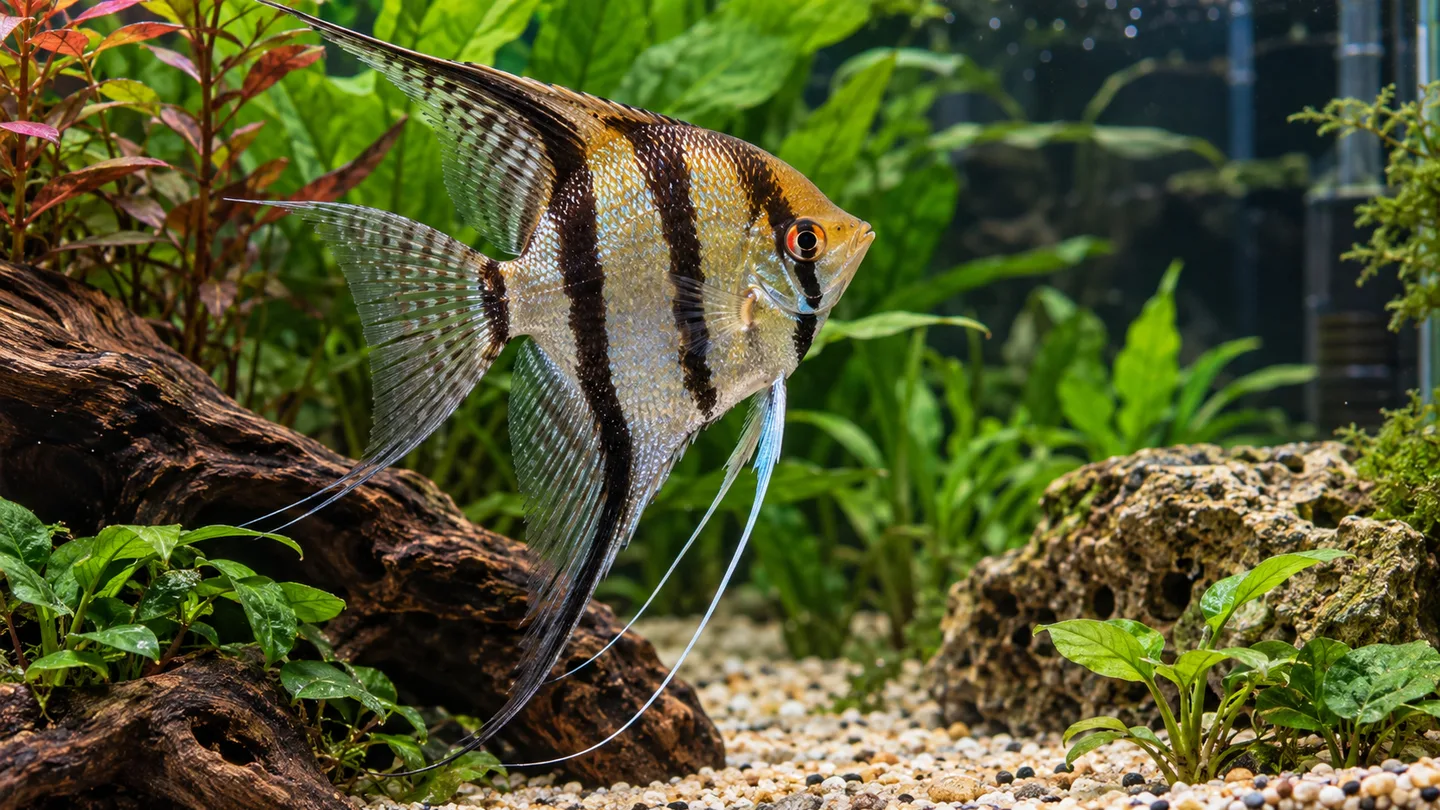
Adult size changes the equation
Angelfish develop a larger mouth and stronger predatory response as they mature. A small tetra that was ignored by a juvenile may later be treated as prey.
A proper neon school still matters
Neon tetras should be kept in a real social group. The RSPCA identifies tetras as shoaling fish and recommends six or more for shoaling tropical species.
Planting reduces stress, not predation ability
Dense plants and wood can provide refuge and break sight lines, but they cannot guarantee safety once a size mismatch exists.
Choose the community for the adult fish
If you want an angelfish-centred community, larger peaceful schooling fish are usually more predictable than very small tetras.
Related aquarium tools and guides
Frequently asked questions
Will angelfish definitely eat neon tetras?
No, but the risk is real and increases as angelfish mature.
Does raising them together make the pairing safe?
Not reliably. Familiarity does not remove the adult size and predation risk.
Can a larger neon tetra school prevent predation?
A school supports tetra welfare but cannot make individual tetras too large to swallow.
Sources and further reading
This guide separates general aquarium arithmetic from fish-welfare decisions. For species-specific limits, always check the needs of the fish you intend to keep.