Neon tetras are shoaling fish and should not be kept alone or as a pair. The RSPCA recommends groups of six or more for shoaling tropical fish such as tetras. In a suitably sized aquarium, a larger school can look and behave more naturally, but the group still has to fit the available swimming space, filtration and total bioload.
The number six is best treated as a minimum social baseline, not an ideal maximum. A school works because the fish can interact with their own species and spread normal social behaviour across the group.
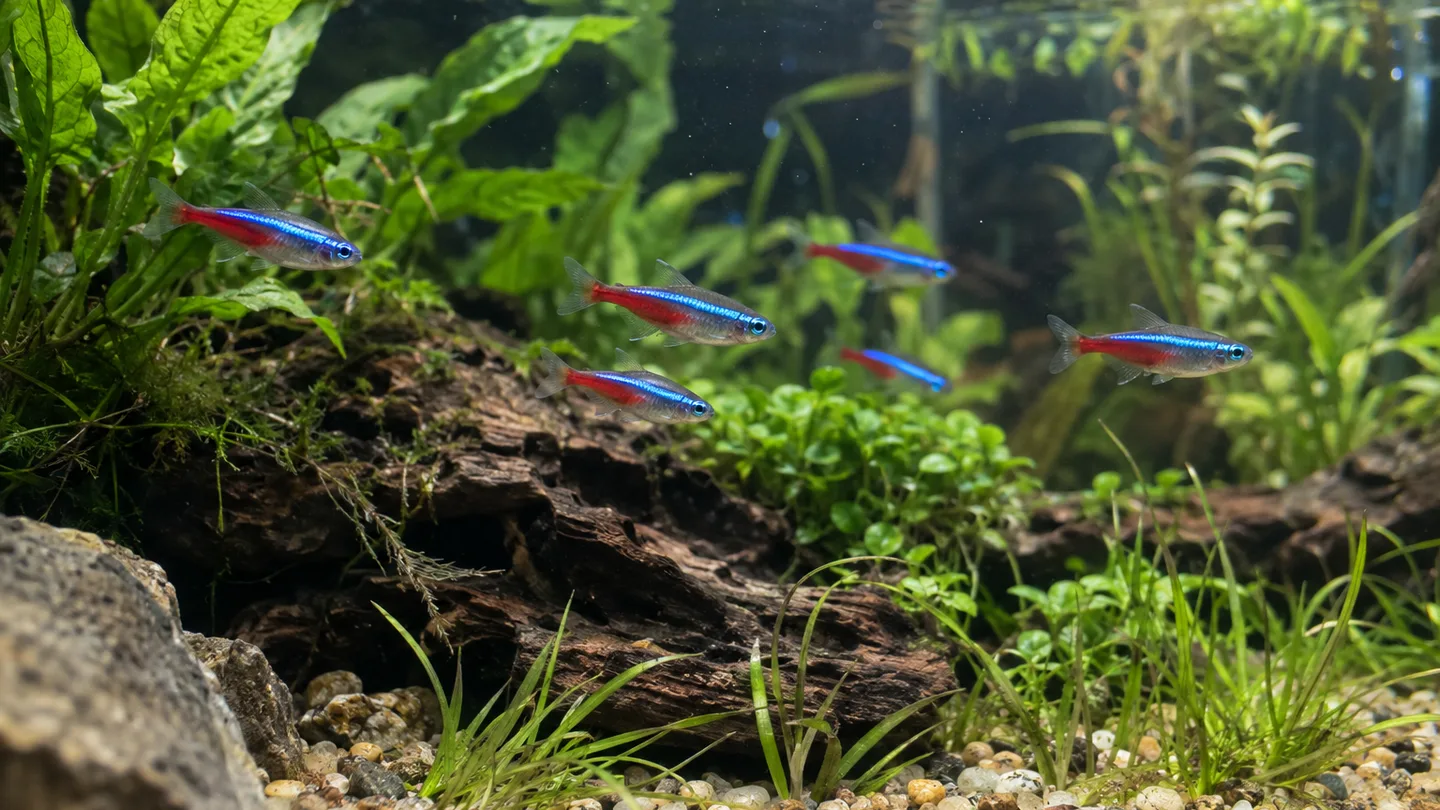
Why a school matters
- Reduces isolation stress.
- Encourages more confident mid-water activity.
- Spreads social attention across multiple fish.
- Makes hiding and scattered behaviour less likely in suitable conditions.
Why larger can be better
A larger school often produces more coordinated behaviour and can make individual fish feel less exposed, provided the tank is not crowded.
Tank footprint still limits the group
Do not increase the school indefinitely because 'more is better'. Neon tetras need open horizontal swimming space as well as cover, and the aquarium must maintain stable oxygen and water quality.
Do not use tank mates as a substitute for neon companions
A betta, Corydoras or guppy does not replace another neon tetra. Social needs are species-specific.
Related aquarium tools and guides
Frequently asked questions
Can I keep three neon tetras?
That is below the usual welfare recommendation for shoaling fish.
Is six neon tetras enough?
Six is a useful minimum baseline; more can be appropriate in a larger aquarium.
Do other tetras count toward the neon school?
No. A mixed collection of different tetra species is not the same as a proper neon tetra group.
Sources and further reading
This guide separates general aquarium arithmetic from fish-welfare decisions. For species-specific limits, always check the needs of the fish you intend to keep.