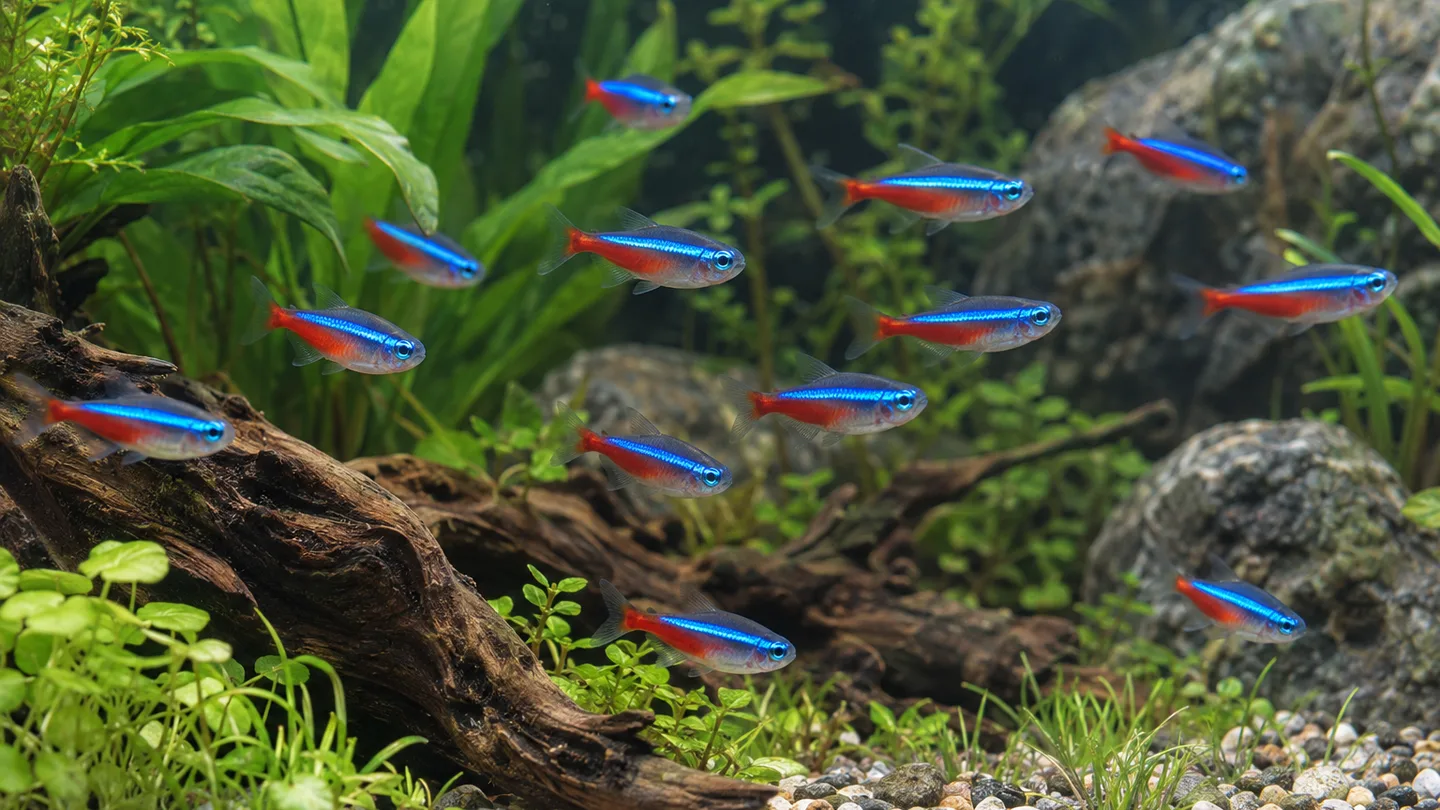
Suitable neon tetra tank mates often include peaceful Corydoras, small rasboras and other calm community species with overlapping temperature and hardness needs. The neon tetra school itself comes first: tetras are social fish and should be kept in a proper group. Avoid fish large enough to swallow them, aggressive cichlids and combinations that require very different water chemistry.
Neon tetras are small enough to become prey and social enough to suffer when under-grouped. The best tank-mate list therefore starts with two filters: the companion must not hunt them, and the aquarium must still leave room for a full tetra school.
Good companion traits
- Peaceful, non-predatory behaviour.
- Adult mouth size too small to swallow neon tetras.
- Overlapping temperature and hardness needs.
- Different or compatible swimming zones.
- No need for territorial space that crowds the tetra school.
Keep the tetra school intact
The RSPCA notes that tetras are shoaling fish and recommends keeping shoaling tropical fish in groups of six or more. A larger coherent school often behaves more naturally than a token group.
Bottom-dwellers can use space efficiently
Peaceful bottom-oriented fish such as suitable Corydoras can complement mid-water tetras when the footprint is large enough and both species have proper group sizes.
Avoid predatory size mismatches
A fish does not need to be 'aggressive' to eat a neon tetra; it only needs to be large enough and opportunistic. Adult size matters more than the size of juveniles in the shop.
Related aquarium tools and guides
Frequently asked questions
Can neon tetras live with Corydoras?
Often yes when temperature, group sizes and tank footprint suit both.
Can neon tetras live with angelfish?
It is risky because adult angelfish can treat small tetras as prey.
How many neon tetras should I keep?
Keep a proper school; six or more is a useful minimum welfare baseline for shoaling fish.
Sources and further reading
This guide separates general aquarium arithmetic from fish-welfare decisions. For species-specific limits, always check the needs of the fish you intend to keep.