Betta fish and neon tetras can sometimes share a warm freshwater aquarium, but the setup needs enough space for a proper tetra school plus the betta's territory. Keep the tetras in a group rather than as scattered individuals, provide plants and sight breaks, and watch for either betta aggression or tetra fin-nipping. If chasing, damaged fins or constant hiding develops, separate them.
This pairing is popular because the fish occupy different visual roles in the tank, but popularity does not make it automatic. Neon tetras are social fish and a betta is territorial, so the aquarium has to meet both sets of behavioural needs.
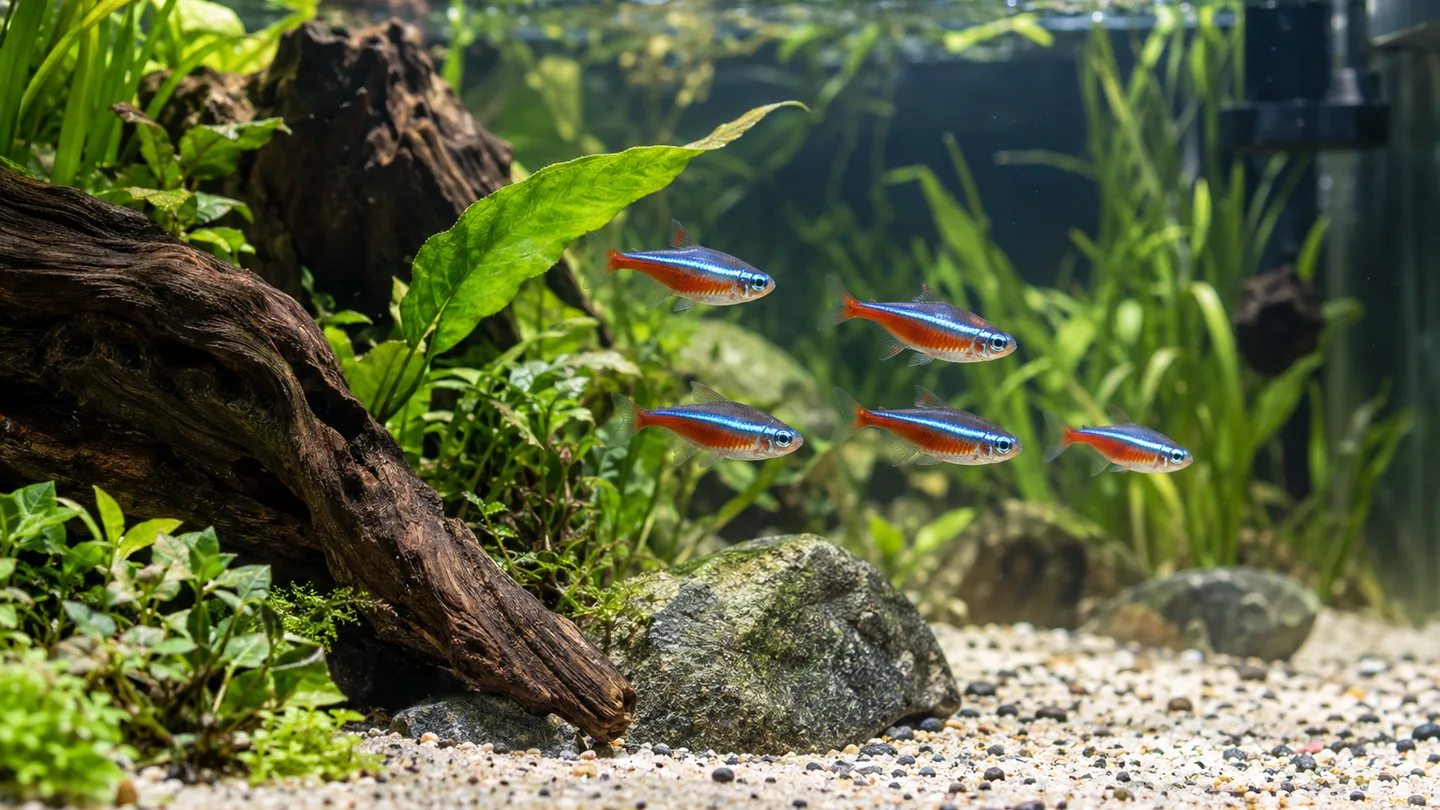
Why the pairing can work
- Neon tetras are small schooling fish rather than territorial cichlids.
- A full school focuses much of its activity on its own group.
- Plants and hardscape can break direct sight lines.
- Both species are commonly kept in warm freshwater conditions, provided the chosen temperature suits both.
Do not under-size the tetra group
The RSPCA advises that many tetras are shoaling fish and should be kept in groups of six or more. A proper group is not optional decoration; it is part of their welfare.
That social requirement also increases the tank space needed for the pairing.
Main risks to watch
- The betta repeatedly chasing the school.
- Tetras nipping the betta's fins.
- The betta guarding a corner or feeding area.
- The tetras losing colour, hiding or scattering abnormally.
A larger planted tank is easier
Extra horizontal swimming space lets the tetra school move without continually crossing the betta's immediate territory. Dense planting at the sides and rear can create refuge without removing open mid-water swimming room.
Related aquarium tools and guides
Frequently asked questions
How many neon tetras should live with a betta?
Keep a proper social group; the RSPCA recommends six or more for shoaling fish such as tetras.
Can neon tetras nip betta fins?
They can, particularly when stressed or kept in unsuitable groups. Monitor the betta's fins.
What if the betta chases them?
Persistent chasing means the combination is not working and separation may be needed.
Sources and further reading
This guide separates general aquarium arithmetic from fish-welfare decisions. For species-specific limits, always check the needs of the fish you intend to keep.