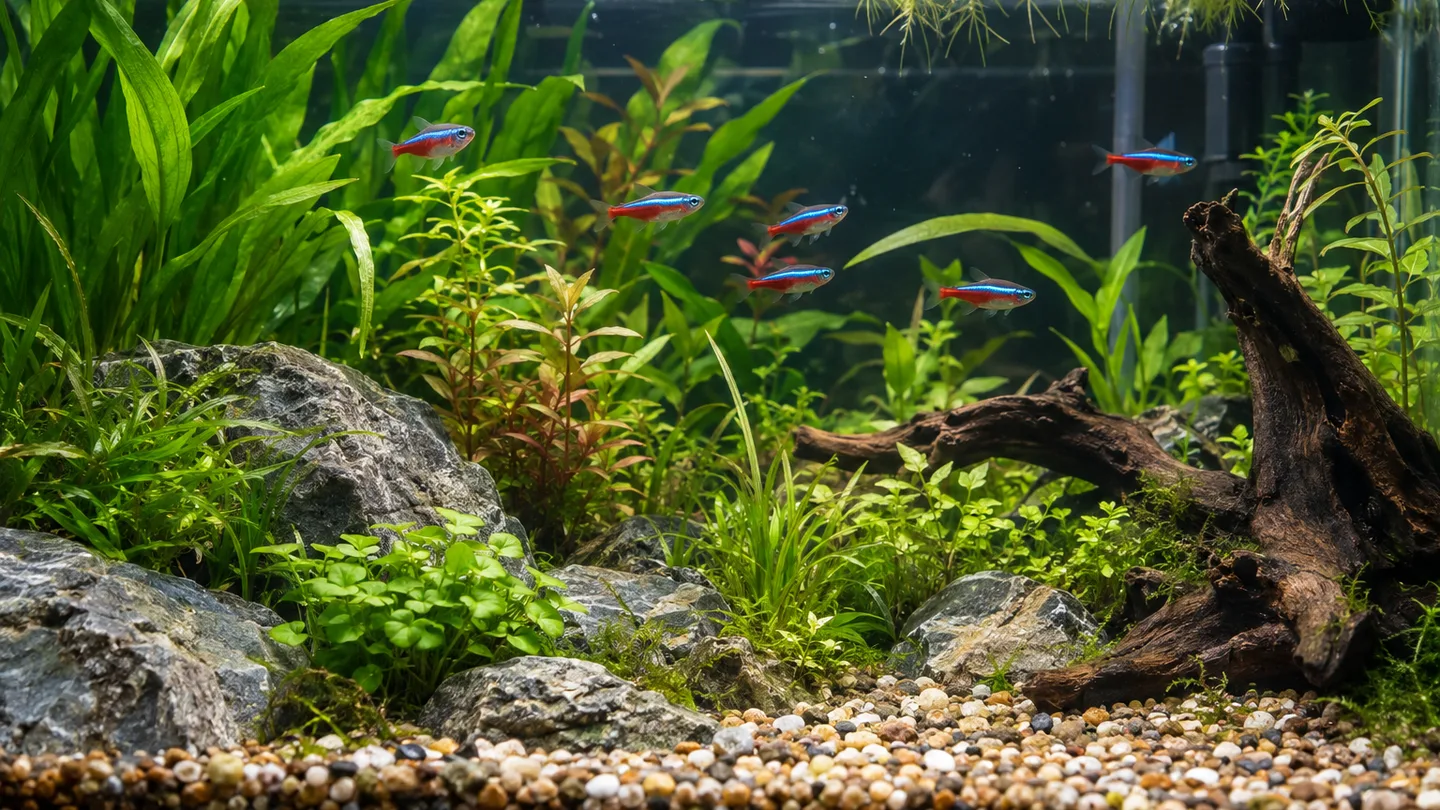
Place the main hardscape or plant mass slightly off-centre, often near a rule-of-thirds intersection, rather than exactly in the middle. Create depth with a lower foreground, taller background and a substrate slope that rises toward the rear. Repeat rock or wood direction for visual flow, keep negative space intentional and make sure every structure is stable and suitable for the fish.
Aquascaping is visual design inside a living system. Composition rules help a tank look natural and balanced, but they are tools rather than laws. If a beautiful rock arrangement blocks a territorial fish from having enough space or creates unstable stonework, husbandry wins.
Start with one main focal point
A tank with five equally dramatic features can feel chaotic because the eye has nowhere to settle. Choose one dominant hardscape mass or plant group and let secondary elements support it.
Placing the focal area off-centre often feels more natural than putting the largest rock directly in the geometric middle.
Use the rule of thirds as a guide
Imagine the front glass divided by two vertical and two horizontal lines into nine rectangles. The intersections are useful candidate positions for a focal rock, piece of wood or strong plant mass.
Do not force every object onto the grid. The rule simply helps avoid accidental symmetry.
Create depth with scale and slope
- Use finer or smaller details toward the rear to suggest distance.
- Slope substrate upward toward the back where the layout allows it.
- Keep the foreground lower and more open.
- Use taller plants behind lower species.
- Angle wood and stone so the eye is led into the composition rather than out through the side glass.
Negative space is part of the design
Open sand, a clear swimming lane or an uncluttered patch of substrate gives the eye contrast. Filling every centimetre with a different ornament usually makes a tank feel smaller.
Negative space also has practical value for feeding, observing fish and siphoning debris.
Stability and livestock needs come first
Large rocks should sit securely and should not be able to collapse if digging fish move substrate. Sharp edges, narrow traps and unstable piles can injure fish.
Leave enough open water for active swimmers and enough cover for shy species. A composition that ignores behaviour is not a successful aquarium design.
Related aquarium tools and guides
Frequently asked questions
What is the rule of thirds in aquascaping?
It is a composition guide that divides the visible tank into thirds horizontally and vertically. Focal elements placed near the intersections often feel more natural than exact centring.
How do I make an aquarium look deeper?
Use a substrate slope, smaller details toward the rear, overlapping hardscape and plant height transitions from foreground to background.
Should aquarium rocks sit on top of deep substrate?
Heavy rocks should be stabilised so digging animals cannot undermine them. Exact placement depends on the rock, tank base and layout design.
Sources and further reading
This guide separates general aquarium arithmetic from fish-welfare decisions. For species-specific limits, always check the needs of the fish you intend to keep.