During fishless cycling, nitrite commonly rises after ammonia begins falling because ammonia-oxidising microbes are working before the nitrite-processing population has fully caught up. The exact level and duration vary by method. Avoid obsessing over an exact peak; keep the filter running, follow the ammonia-dosing protocol and wait until nitrite is processed back to zero. With fish present, nitrite should be kept as close to zero as possible.
Nitrite is the stage where many beginners think the cycle has stalled. Ammonia suddenly disappears, but the nitrite test seems to stay at the top of its colour chart. That can still be normal progress because the second microbial community often takes longer to build enough capacity.
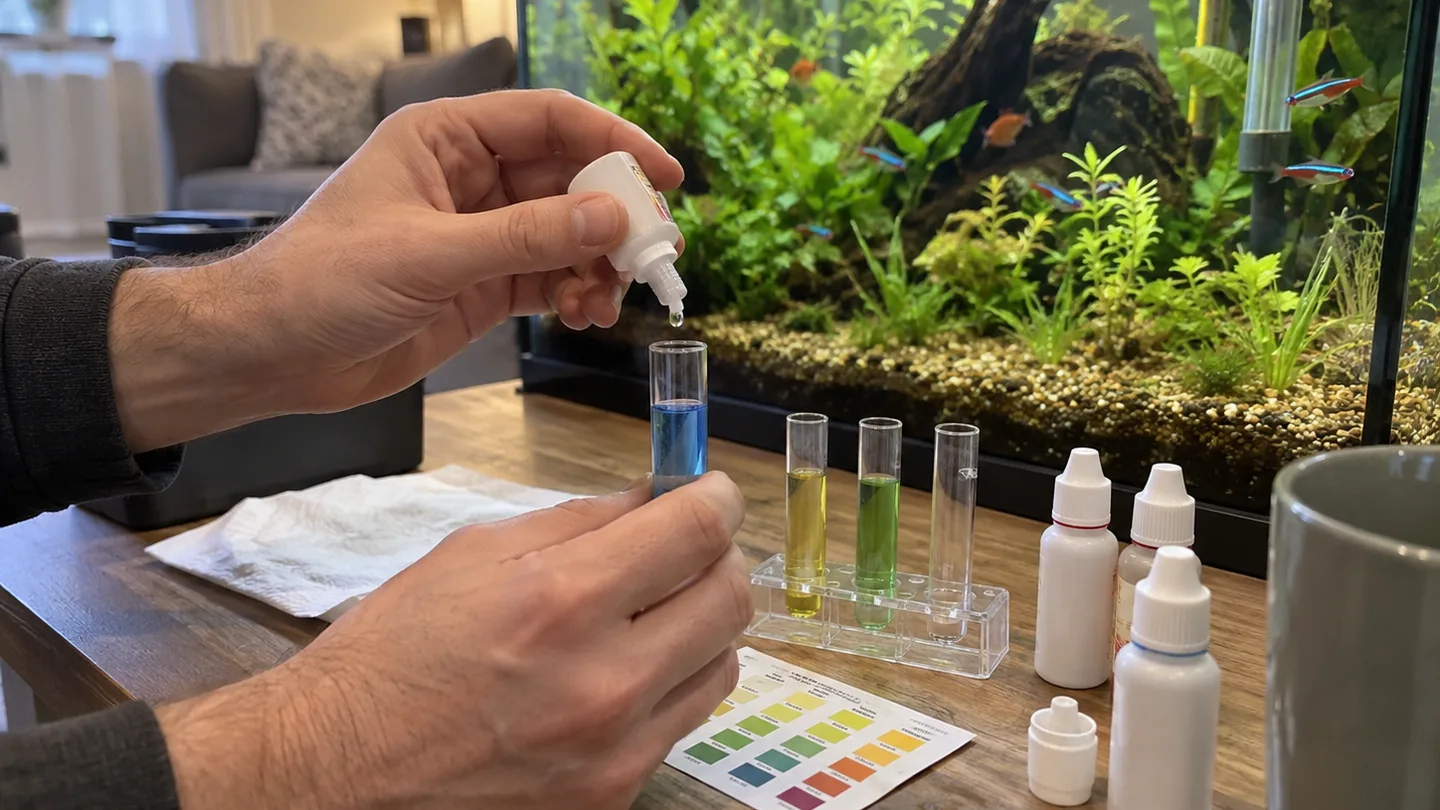
Where nitrite comes from
Ammonia-oxidising microorganisms convert ammonia into nitrite. A second group then converts nitrite into nitrate.
Because those groups do not always establish at the same rate, nitrite can accumulate temporarily even after ammonia processing looks strong.
Why very high nitrite is hard to interpret
Many hobby test kits have an upper reading limit. Once the colour is at the top of the scale, you may not know whether the true concentration is slightly above it or many times higher.
That is why following a sensible ammonia dose matters. Extreme ammonia dosing can create an unnecessarily large nitrite backlog.
What to do during the nitrite stage
- Keep the filter running continuously.
- Maintain stable temperature and oxygenation.
- Continue the cycling method without repeatedly redosing excessive ammonia.
- Check pH if progress seems to stop.
- Allow time for the nitrite-processing community to develop.
If fish are present
Nitrite interferes with normal oxygen transport in fish and should be treated as a serious water-quality issue. Use conditioned water changes to keep exposure low while biological filtration matures.
Do not wait for fish to show obvious distress before acting on a positive nitrite test.
The finish line
A cycled aquarium should process nitrite back to zero under the waste load represented by your cycling method. One zero reading after days without any ammonia input is not enough evidence.
Confirm ammonia and nitrite processing together.
Related aquarium tools and guides
Frequently asked questions
Why is nitrite high when ammonia is zero?
The first stage of nitrification has developed faster than the second. This is a common mid-cycle pattern.
How long does the nitrite stage last?
It can last days or weeks depending on conditions and seed bacteria. There is no fixed duration.
Should I add more bacteria when nitrite is high?
A reputable nitrifying culture may help if viable, but stable conditions and time are still required. More products are not a substitute for correct pH, oxygen and filter flow.
Sources and further reading
This guide separates general aquarium arithmetic from fish-welfare decisions. For species-specific limits, always check the needs of the fish you intend to keep.