A white or grey haze that appears days after a new aquarium is started is often a bacterial bloom caused by rapidly growing heterotrophic bacteria feeding on available organics. Cloudiness present immediately after filling is more likely to be substrate dust. In either case, test ammonia and nitrite if fish are present, keep the filter running and avoid adding unnecessary chemicals or extra livestock while the tank stabilises.
Bacterial blooms are common enough that many beginners are told to ignore every cloudy new tank. That is too simple. The haze itself may be harmless, but a new aquarium is also the time when ammonia and nitrite problems are most likely. Diagnose the appearance and the water chemistry separately.
What a bacterial bloom looks like
A bacterial bloom often creates uniform white, grey or milky water rather than visible floating particles. It may appear after the aquarium has been running for a few days as dissolved organics become available.
The bacteria responsible are not necessarily the same nitrifying organisms that establish the aquarium's biological filter, so the bloom does not prove the tank is cycled.
How to distinguish dust from bloom
| Clue | Substrate dust | Bacterial bloom |
|---|---|---|
| Timing | Immediately during/after filling | Often develops after a day or more |
| Appearance | Fine visible particles or mineral haze | Uniform milky/white haze |
| Cause | Disturbed gravel, sand or aquasoil | Rapid microbial growth on organics |
| Response | Mechanical filtration and settling | Often clears as system stabilises |
What to do first
- Test ammonia and nitrite if fish are present.
- Check filter flow and keep biological filtration running.
- Remove obvious excess food or decaying material.
- Avoid adding more fish while the aquarium is unstable.
- Give the system time unless water tests show a problem requiring action.
When a water change makes sense
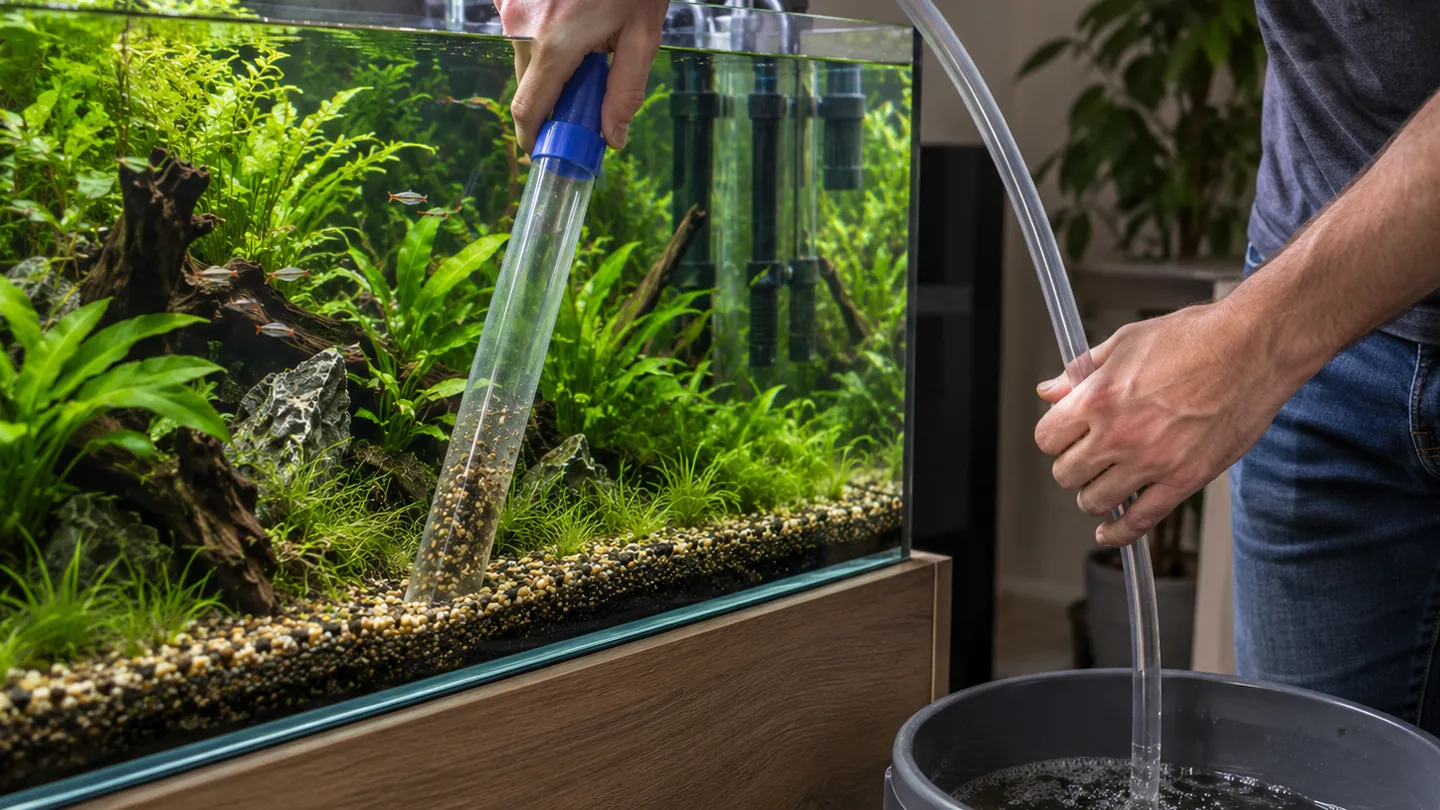
If ammonia or nitrite is detectable with fish in the tank, use conditioned partial water changes to protect livestock while addressing the immature cycle.
If water quality is safe and the bloom is simply cosmetic, repeated massive water changes may not be necessary and can make it harder to see whether the system is stabilising.
When cloudiness is not just a new-tank bloom
- The water is green rather than white.
- There is a strong foul or rotten smell.
- Fish are gasping or breathing rapidly.
- Cloudiness begins after a dead fish, heavy overfeeding or major filter failure.
- The tank has been mature and stable for months and suddenly turns cloudy.
Related aquarium tools and guides
Frequently asked questions
How long does a bacterial bloom last in a new aquarium?
Many clear within several days to a couple of weeks as the system stabilises, but persistent cloudiness should prompt checks of feeding, filtration and water chemistry.
Should I turn the filter off during a bacterial bloom?
No. Keep filtration and circulation running unless equipment instructions or a specific treatment require otherwise.
Does a bacterial bloom mean my aquarium is cycled?
No. A bloom can happen before nitrifying bacteria are established. Test ammonia and nitrite to assess the cycle.
Sources and further reading
This guide separates general aquarium arithmetic from fish-welfare decisions. For species-specific limits, always check the needs of the fish you intend to keep.