A 50% water change is not automatically too much. In a stable freshwater aquarium, it can be an effective way to cut nitrate or another dissolved compound roughly in half. The important factors are chlorine or chloramine treatment, temperature, pH and mineral differences between old and new water. If replacement water is very different, a large sudden change can stress fish even though the percentage itself is not the problem.
Some fishkeepers avoid large water changes because they fear removing beneficial bacteria. Most nitrifying bacteria live on filter media and surfaces, not floating freely in the water, so a large water change does not normally erase the cycle.
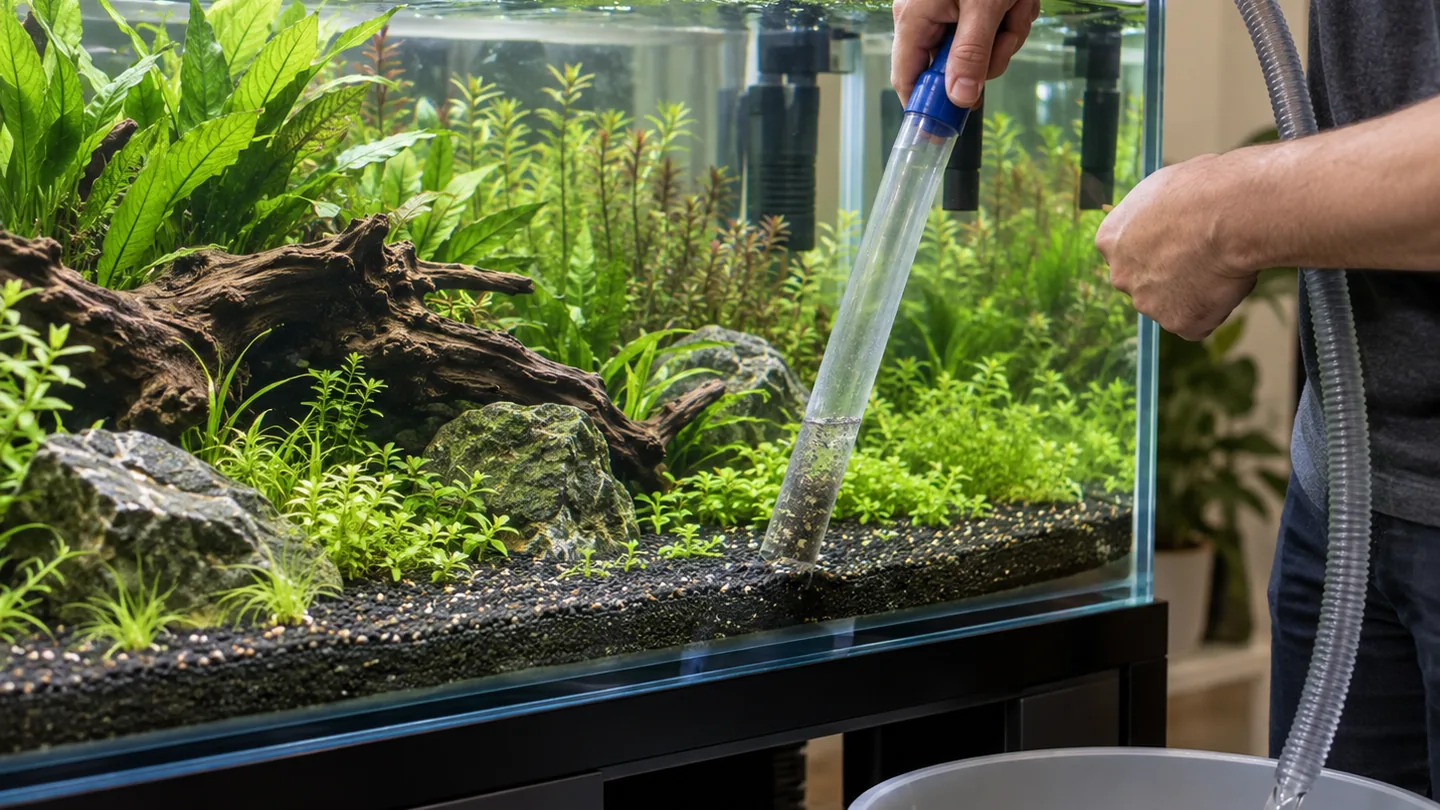
When 50% can be useful
- High nitrate that needs meaningful dilution.
- Detectable ammonia or nitrite in a stocked aquarium.
- An accidental overdose or contaminant that can be diluted safely.
- A heavily stocked tank whose routine requires larger changes.
When to be more cautious
- Tap and tank pH differ greatly.
- GH or KH is very different between replacement and aquarium water.
- Replacement water temperature is poorly matched.
- Fish are already severely stressed and the new water has not been prepared carefully.
- The aquarium has been neglected for a long time and chemistry has drifted far from the source water.
Large changes do not remove the biofilter
Beneficial bacteria live mainly on filter media, substrate and other wet surfaces. Replacing half the water leaves those colonies in place.
The bigger cycle risk is cleaning or replacing biological media aggressively at the same time.
Prepare the new water first
Condition municipal tap water, match temperature and understand the source-water pH, GH and KH. If you use RO, prepare the correct blend or remineralisation before it enters the tank.
The larger the change, the more the replacement water determines the final chemistry.
Retest after problem-solving changes
If the change was made for ammonia, nitrite or very high nitrate, retest once the tank is mixed. Repeat corrective changes if necessary rather than assuming one change solved the underlying cause.
Frequently asked questions
Will a 50% water change crash my cycle?
Normally no. The main bacterial colonies are attached to surfaces and filter media rather than living in the water column.
Can I do two 50% water changes in one day?
In an emergency it can be appropriate if the replacement water is suitable, but diagnose the cause and watch for chemistry or temperature differences.
Is 50% too much for shrimp?
Sensitive livestock may react to rapid mineral or temperature shifts, so closely matched replacement water is especially important.
Sources and further reading
This guide separates general aquarium arithmetic from fish-welfare decisions. For species-specific limits, always check the needs of the fish you intend to keep.