Use a stand designed for the tank's dimensions and loaded weight, with the correct perimeter or full-base support specified by the manufacturer. The top should be flat and rigid, the cabinet should not rack or wobble, and there should be enough access for filters, hoses and electrics. Level the stand before filling the aquarium.
A stand becomes part of the aquarium structure once the tank is full. It carries not only water but glass, substrate, rock, wood and equipment, often continuously for years. Cosmetic furniture that happens to be the right width is not automatically a safe substitute.
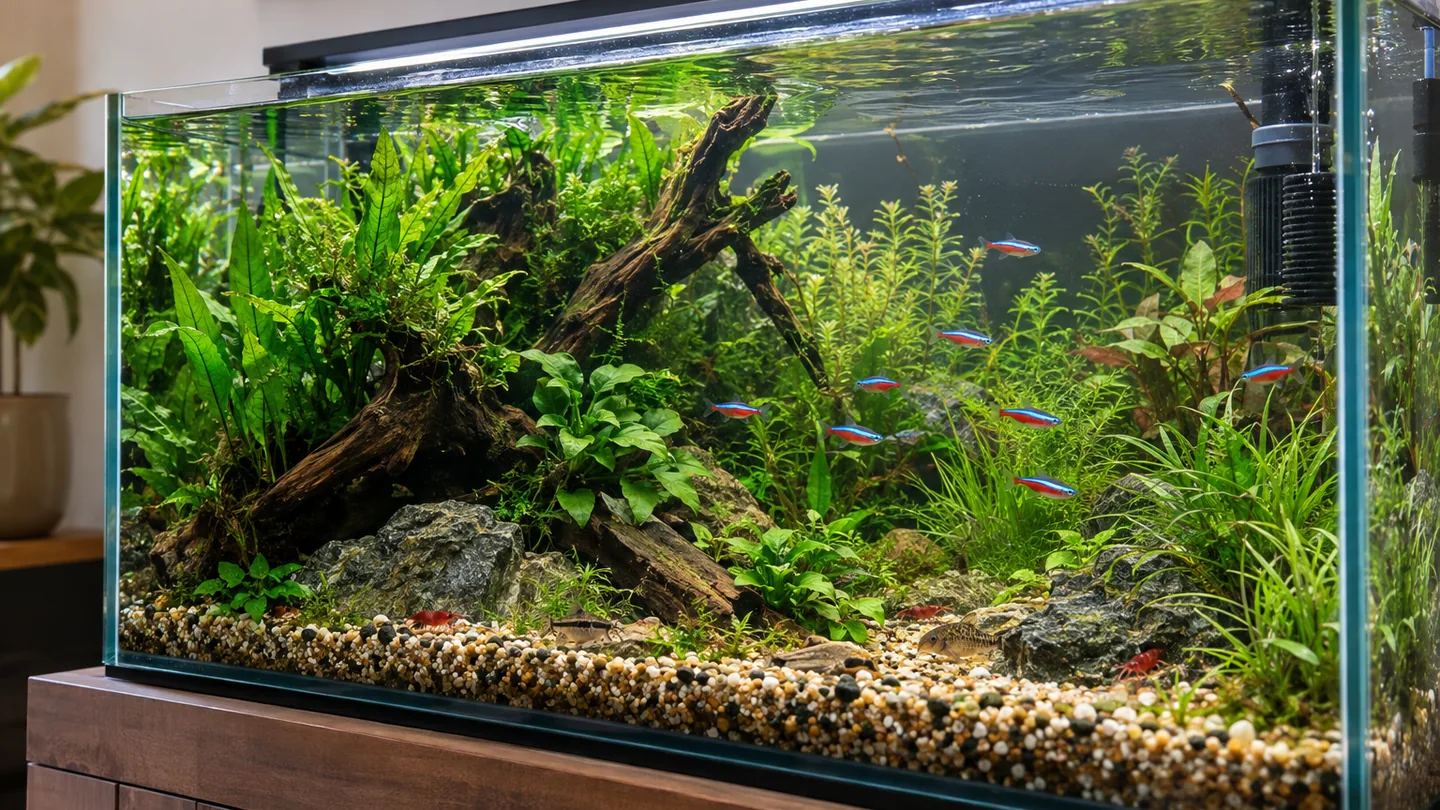
Check the support pattern first
Some framed tanks are designed to sit on the perimeter frame, while many rimless and acrylic systems require continuous support across the base. The stand must match that design.
If the aquarium maker specifies a particular mat, top surface or cabinet, follow that requirement rather than improvising.
Estimate the real loaded weight
Water weighs about 1 kg per litre before the weight of the aquarium itself is added. Substrate, rock, wood, filter water and cabinet hardware add more.
Use a tank-weight calculation to get into the right order of magnitude, then make sure the stand rating is appropriate for the complete system.
Look for stiffness, not just strength
A stand can be strong enough not to collapse yet still be unsuitable if the top bows, twists or allows the aquarium to rock. Rigidity matters because the tank needs stable support across the points it was designed to bear on.
Check doors and panels close squarely, the cabinet does not rack when pushed gently and the top is flat.
Plan the inside of the cabinet
- Enough room for a canister filter if used.
- Hose openings that do not kink tubing.
- Safe dry positioning for power strips and controllers.
- Ventilation around electrical equipment.
- Access to valves and filter lids without dismantling the cabinet.
- Space for maintenance tools without crowding live electrics.
Moisture resistance matters
Aquarium cabinets live around splashes and condensation. Wipe spills quickly and protect unfinished composite-board edges from repeated wetting.
If using a timber DIY stand, seal it appropriately and ensure the structural design is suitable for the load rather than relying on appearance.
Related aquarium tools and guides
Frequently asked questions
Can I use any cabinet that holds the weight?
Not safely by weight alone. The cabinet also needs the correct support pattern, stiffness, footprint and moisture resistance for the aquarium.
Does an aquarium stand need to be perfectly level?
It should be level and stable within practical installation tolerances. More importantly, it should not twist or rock. Correct the stand before filling.
Can I build my own aquarium stand?
Yes if you understand the tank's support requirements and can build a rigid, level structure for the full load. For large tanks, engineering advice may be sensible.
Sources and further reading
This guide separates general aquarium arithmetic from fish-welfare decisions. For species-specific limits, always check the needs of the fish you intend to keep.