Unlike ammonia and nitrite, nitrate does not have one universal freshwater target that suits every species and system. It is the end product of normal biological filtration and tends to accumulate unless plants, water changes or specialised filtration remove it. Use your species' requirements, source-water nitrate and the tank's normal baseline to set a conservative target, and investigate any persistent upward trend.
Aquarium advice often gives one nitrate cutoff as if every fish, shrimp, plant and tap-water supply were identical. They are not. Nitrate is useful because it shows how waste is accumulating, but the right response depends on context.
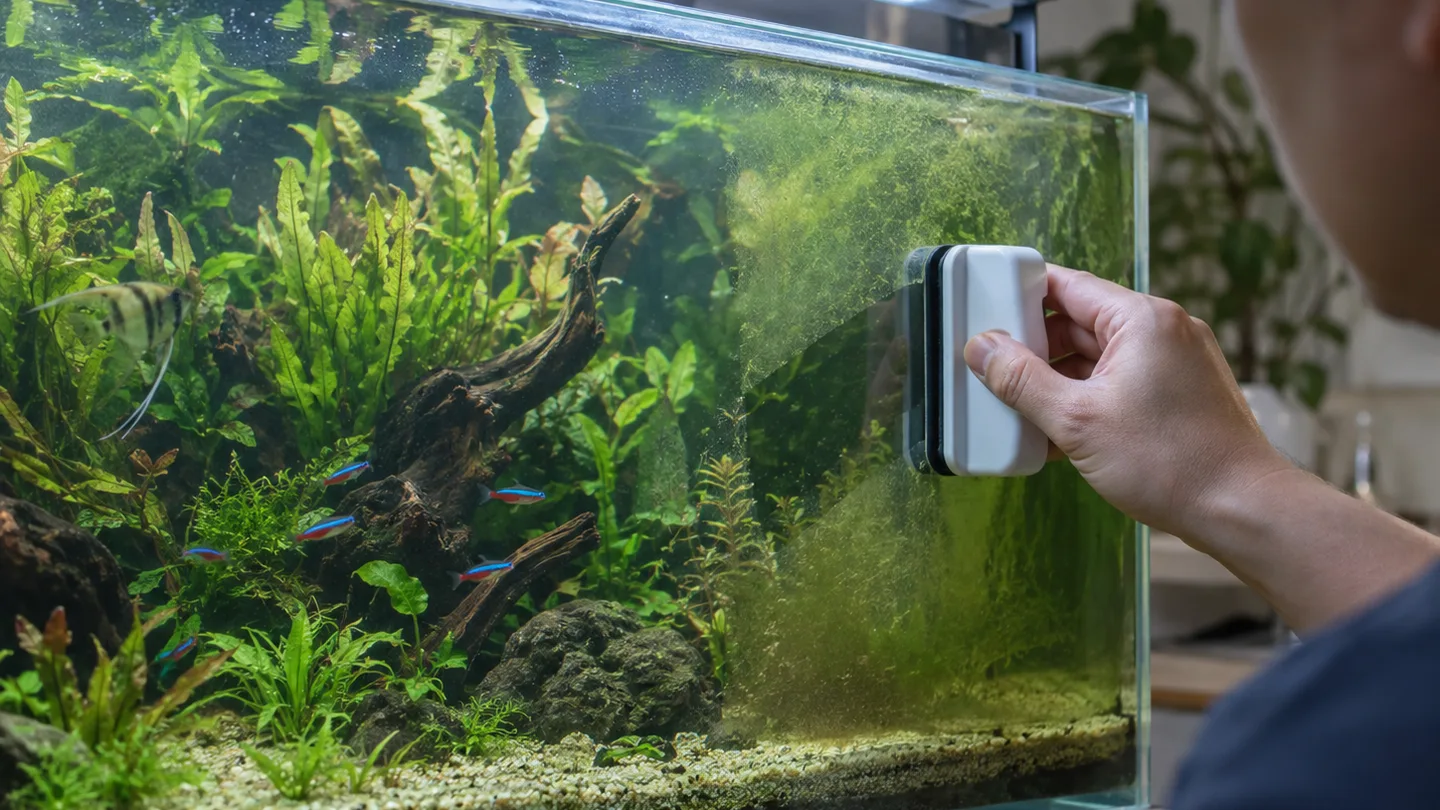
Why nitrate behaves differently from ammonia and nitrite
A mature biofilter converts ammonia to nitrite and then nitrate. That makes nitrate a normal end product of the nitrogen cycle.
It is generally safer than ammonia or nitrite, but high levels can still cause chronic stress and indicate that maintenance is not keeping up with waste production.
What should determine your target
- The species and life stage you keep.
- Whether the tank contains sensitive shrimp or fry.
- Nitrate already present in the tap or source water.
- How heavily the aquarium is stocked and fed.
- How many fast-growing live plants are present.
- Your normal water-change schedule and baseline trend.
Why one-off readings are less useful than trends
A stable tank that stays near its usual baseline tells a different story from one whose nitrate climbs every week. Record results before water changes so you can see whether the system is gradually accumulating more waste.
If nitrate keeps rising, review feeding, stocking, detritus, plant growth and water-change volume.
Water changes remain the simplest control
The RSPCA notes that nitrate can become problematic at high levels and recommends regular partial water changes because biological filtration does not remove all end products.
Use the water-change calculator to estimate how much dilution a planned change will provide.
Check the source water
If tap water already contains nitrate, repeated water changes may not lower the tank as far as expected. Test the source separately before assuming the aquarium is producing all of it.
In special cases, alternative source water or nitrate-reduction methods may be justified, but those choices should be based on measured need.
Related aquarium tools and guides
Frequently asked questions
Is zero nitrate always best?
Not necessarily. Heavily planted tanks may run very low, but zero is not required for every healthy aquarium and can reflect rapid plant uptake rather than a special safety threshold.
Why is nitrate high after a water change?
The source water may contain nitrate, the change may have been too small for the starting level, or waste production may be high.
Can plants lower nitrate?
Yes. Growing plants use nitrogen, especially fast growers, but plant uptake does not replace testing and maintenance.
Sources and further reading
This guide separates general aquarium arithmetic from fish-welfare decisions. For species-specific limits, always check the needs of the fish you intend to keep.