Staghorn algae grows in branching strands that resemble antlers and often appears on plant edges, equipment and hardscape. Manually remove what you can, prune badly affected leaves and review lighting, nutrient balance and plant health. Like other stubborn filament algae, it tends to return if the aquarium remains unstable. Targeted peroxide treatment is sometimes used by experienced fishkeepers, but environmental correction is the safer foundation.
Staghorn algae is easy to confuse with ordinary hair algae until you look closely at its forked branches. Correct identification helps you avoid wasting time on a one-size-fits-all algae cure.
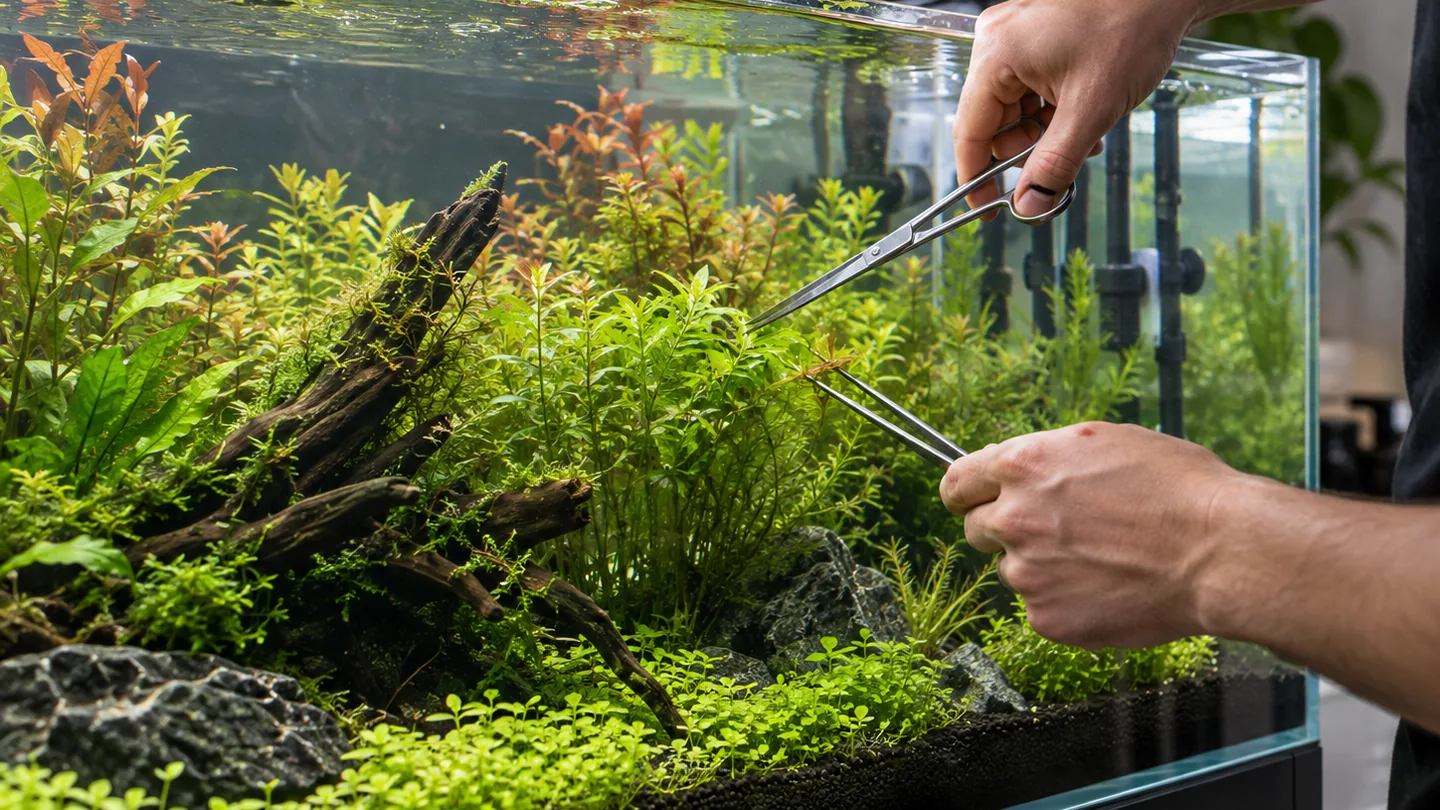
How to recognise staghorn algae
The strands branch repeatedly rather than growing as simple green threads. Colour can range from grey-green to dark grey or reddish as it dies.
Remove the worst growth
- Trim badly affected leaves.
- Brush removable hardscape outside the tank.
- Clean equipment during normal maintenance.
- Siphon loosened pieces so they do not settle elsewhere.
Review stability
In planted aquariums, large changes in light, fertiliser or carbon availability can favour opportunistic algae. Keep the photoperiod consistent and make gradual adjustments.
Healthy fast-growing plants are a better long-term competitor than repeated harsh treatments.
Targeted treatment is optional, not the first step
Some aquarists use hydrogen peroxide on removable decor or exposed areas, but sensitive plants and livestock can be harmed by careless dosing. If used, follow a conservative, well-documented method rather than improvising.
Related aquarium tools and guides
Frequently asked questions
Is staghorn algae the same as hair algae?
No. Both are filamentous, but staghorn has characteristic branching strands.
Will algae eaters remove staghorn algae?
Some animals may graze weakened growth, but they rarely solve an established outbreak by themselves.
Does staghorn algae mean my water is dirty?
Not necessarily. It more often reflects an imbalance in light, nutrients, carbon availability or plant growth.
Sources and further reading
This guide separates general aquarium arithmetic from fish-welfare decisions. For species-specific limits, always check the needs of the fish you intend to keep.